
RajasBhumi — Jahan Har Safar Ek Kahani Hai. Every city has a list of monuments, but Jaipur has a list of stories — each fort, gate, and lane carries a piece of Rajasthan’s history within its walls. From royal courtyards to hilltop sunsets, this city rewards anyone willing to slow down and look closer. Here are ten places that capture what makes a Jaipur trip unforgettable, whether you’re here for a day or a full week.
Amer Fort Jaipur: History, Sheesh Mahal and Complete Travel Guide
Visit Jaipur and skip Amer Fort, and your trip feels incomplete. When the soft morning sun settles over the Aravalli hills and this red-and-gold sandstone fort glows above Maota Lake, it feels like an old story has come alive. Amer Fort Jaipur is the city’s grandest fort and has been a UNESCO World Heritage Site since 2013. This guide covers its history, must-see spots, timings, practical tips and a few hidden places most tourists miss.
History of Amer Fort: A 900-Year Story
From the Meenas to the Kachwahas
The Amer region was once held by the Meena tribe. Around the 11th century, the Kachwaha Rajputs took control and made Amer their capital. The Kachwahas trace their lineage to Kush, son of Lord Ram. From this modest hill fortress began the rise of one of Rajasthan’s most powerful kingdoms.
Man Singh I and the Mughal Alliance
In 1562, Raja Bharmal of Amer allied with Emperor Akbar, and his daughter’s marriage to Akbar made the Kachwahas one of the first major Rajput houses to ally with the Mughals. His grandson, Raja Man Singh I, became one of Akbar’s most trusted generals, leading campaigns from Kabul to Bengal. With that wealth and influence, he began building the present Amer Fort in 1592, replacing the older fortress. It is believed that the idol of Shila Devi was brought to Amer after his Bengal campaign.
Jai Singh I and Sawai Jai Singh II
The fort gained much of its grandeur under Mirza Raja Jai Singh I (1621–1667), who added palaces like Sheesh Mahal and Sukh Niwas and blended Rajput and Mughal styles beautifully. Sawai Jai Singh II made further additions later.
When the Capital Moved to Jaipur
As Amer’s population grew and water became scarce in the hills, Sawai Jai Singh II founded Jaipur in 1727, about 11 km away, and shifted the capital there. Amer stopped being the capital but remained a place for royal rituals and celebrations. In 2013, UNESCO included it among the six “Hill Forts of Rajasthan” on the World Heritage list.
Amer Fort timeline at a glance
- 11th century: Kachwaha Rajputs begin ruling Amer
- 1562: Raja Bharmal’s alliance with Akbar
- 1592: Raja Man Singh I begins building the fort
- 1621–1667: Mirza Raja Jai Singh I adds Sheesh Mahal and other palaces
- 1727: Sawai Jai Singh II founds Jaipur, and the capital shifts
- 2013: UNESCO World Heritage Site status
What to See Inside Amer Fort
The main gate, Suraj Pol, faces east towards the rising sun. Inside is Jaleb Chowk, the courtyard where the army once paraded.
Diwan-e-Aam: The king’s public hall, with rows of pillars topped by carved elephants. Imagine the ruler sitting here, listening to his people.
Ganesh Pol: The fort’s most beautiful gateway, covered in colourful mosaics and frescoes. Above it is Suhag Mandir, from where royal women watched court proceedings through latticed windows.
Sheesh Mahal (Jai Mahal): The most famous part of Amer. Its walls and ceiling are covered in thousands of tiny mirrors and coloured glass. It is said that lighting just a couple of lamps here once made the whole room shimmer like a starry sky. Come early for photos, before the crowds arrive.
Sukh Niwas: The royal “natural AC.” Water channels ran through the room, and the breeze passing over them cooled the space even in Rajasthan’s heat.
Shila Devi Temple: A revered temple inside the fort, busiest during Navratri
How to Reach Amer Fort
Amer Fort is about 11 km from Jaipur city centre, and a cab or auto takes 25 to 30 minutes. To reach the top, you can walk or take a jeep. Elephant rides have faced animal welfare questions, so most visitors now choose to walk or take a jeep. The walk takes 10 to 15 minutes, with lovely views of Maota Lake on the way.
Best Time to Visit and Timings
The best season is October to March, when the weather is pleasant. In summer, go at opening time or late afternoon. The fort is generally open from 8:00 AM to 5:30 PM, and a light and sound show runs in the evening. Timings and ticket prices change, so confirm them from an official source before you go.
Hidden Gems Near Amer Fort
- Kesar Kyari Bagh (Maota Lake): Perfect for photos of the fort reflected in the water.
- Panna Meena ka Kund: An old stepwell with striking geometric staircases.
- Anokhi Museum of Hand Printing: A museum in a restored haveli that explains Rajasthan’s block-printing tradition.
Quick Tips
- Wear comfortable shoes, as there are many stairs and slopes.
- Carry water, a cap and sunscreen.
- Keep 2 to 3 hours for the fort.
- Fix the rate in advance if you hire an authorised guide.
- Weekdays are less crowded than weekends.
FAQs
How long does it take to explore Amer Fort?
About 2 to 3 hours.
Who built Amer Fort?
Raja Man Singh I began it in 1592, and Mirza Raja Jai Singh I and Sawai Jai Singh II expanded it.
How far is Amer Fort from Jaipur?
About 11 km from the city centre.
Conclusion:- Amer Fort is not just a monument but a living page of Rajasthan’s history. On your next Jaipur trip, set aside a full morning for it and explore the hidden spots around it too. Rajasbhumi: Jahan Har Safar Ek Kahani Hai
Nahargarh Fort: The Royal Secret Hidden in Jaipur’s Hills
Have you ever visited a place where the noise of the city, the rush of daily life and the constant buzz of phone notifications seem to fade away the moment you arrive? Nahargarh Fort, standing tall on the Aravalli hills of Jaipur, is exactly that kind of place. Down below, the Pink City moves at its own busy pace, while up here cool breezes, weathered walls and centuries-old stories are waiting for you.
If you came to Jaipur and only saw Hawa Mahal, City Palace and Amber Fort, then you have not yet seen the most captivating view this city has to offer. So let us walk into this fort together and find out what its walls have witnessed over the centuries.
The History of Nahargarh: How It All Began
The story of Nahargarh begins in 1734, when Maharaja Sawai Jai Singh II, the founder of Jaipur, laid the foundation of this fort. The city had been established only a few years earlier, and Jai Singh wanted his new capital to be safe from every direction. That is why Nahargarh was built on the hills along with Amber and Jaigarh, so that the three forts together could form a strong ring of protection around Jaipur. Thanks to its height, any movement by an enemy could be spotted from far away. Later rulers also improved and expanded the fort over the years.
Interestingly, the fort was first known as Sudarshangarh. It later came to be called Nahargarh, a name often translated as “abode of tigers.” It is said that tigers once roamed the forests of these hills. But there is another story behind the name, and it is far more intriguing.
The Mysterious Tale of Nahar Singh Bhomia
According to local folklore, strange things began to happen once construction started. Whatever walls the workers raised during the day would collapse on their own at night. This happened not once but again and again, and the labourers grew afraid. Troubled by the delays, the Maharaja consulted priests and holy men for advice.
They told him that the spirit of a prince named Nahar Singh Bhomia wandered on this hill, angry to see a fort rising on the land he considered his own. To calm the restless spirit, a small temple was built in his memory inside the fort, and the fort itself was named Nahargarh after him. It is said that after this, construction was completed without any further trouble. Whether the story is true or simply a cherished belief, nobody can say for sure, but people still visit the temple with great devotion.
Madhavendra Bhawan: One Palace for Nine Queens
The most beautiful part of the fort is Madhavendra Bhawan, built in the late 19th century by Sawai Madho Singh II. Its most remarkable feature is a set of nine identical suites, created for the king’s nine queens. Each suite had its own bedroom, kitchen and sitting area, and all of them were connected by a single shared corridor.
The thinking behind this design was clever. The king could reach the suite of the queen he wished to visit without anyone else knowing, which also reduced the room for jealousy and quarrels among them. Even today, the delicate paintings on the walls and the play of sunlight through the latticed windows carry you back to that era. For photography lovers, this place is nothing short of a treasure.
What to See Inside the Fort
The real soul of Nahargarh is its sunset. In the evening, as the sun sinks behind the Aravallis, the whole of Jaipur below is bathed in golden light. On one side you can spot Jal Mahal resting in the middle of Man Sagar Lake, and on the other, the glittering buildings of the city light up one by one. Sip a cup of tea here and an unforgettable evening is practically guaranteed. If you get hungry, places like Padao inside the fort let you enjoy a meal in the cool mountain air.
There is also an old stepwell inside the fort whose architecture will make you pause and admire it. Water was scarce on the hill, so a special system was created to collect rainwater, an early form of what we now call rainwater harvesting. Bollywood has fallen for this fort too; scenes from films like Rang De Basanti and Shuddh Desi Romance were shot here. There is also a sculpture park and a wax museum, which families and children tend to enjoy.
When and How to Visit
The best time to visit is between October and March, when the weather is pleasant and the air is crisp. The hills turn lush and green during the monsoon and the view is lovely, though you should watch your step on slippery paths. The fort is roughly 15 kilometres from the city centre and is easy to reach by taxi, cab or your own vehicle. The ideal plan is to arrive in the afternoon, explore the fort at a relaxed pace, and stay on until sunset.
Wear comfortable shoes and carry a water bottle and a camera. Tickets and timings change from time to time, so check the official information before you go. Weekends can be crowded, so pick a weekday if you would prefer some peace and quiet.
Final Thoughts
Nahargarh is not just a fort; it is a feeling. History and folklore breathe together here, and the noise of the city fades into a soft hum in the distance. Sitting high above the crowds, it becomes easy to understand why so many people fall in love with this city. Every corner seems to be saying something, if you only pause to listen. So the next time you are in Jaipur, set aside one evening for Nahargarh. I promise you will leave with more than photographs; you will carry a few stories home with you too.
Jaigarh Fort: The Fortress of Victory
Standing Guard Over the Pink City
Imagine standing on a windswept ridge of the Aravalli hills, where the breeze carries the smell of dry earth and warm stone, and the whole of Amer spreads out below you like a painting. That is the feeling Jaigarh Fort gives the moment you step through its gates. Perched on the Cheel ka Teela, the “Hill of Eagles,” about fifteen kilometres from the heart of Jaipur, this sandstone fortress has watched over Rajasthan for nearly three centuries. If Amer Fort is the graceful palace where the Kachwaha kings lived, Jaigarh is the stern elder brother standing right behind it, arms crossed, making sure nobody gets any ideas.
A Fort Born of Ambition
The story begins with the Kachwaha Rajputs, who ruled from Amer. Earlier fortifications on this ridge are often credited to Raja Man Singh I, the celebrated general of Emperor Akbar, but the fort we see today is largely the work of Sawai Jai Singh II, who built it around 1726 and gave it his own name. Jaigarh literally means “Fort of Victory.”
Jai Singh II is remembered mostly as the astronomer-king who founded Jaipur in 1727 and built the Jantar Mantar observatories. But he was also a hard-headed military planner. He knew the palace at Amer sat in a bowl of hills, beautiful but exposed. A fortress on the ridge above would turn that bowl into a trap for any enemy foolish enough to walk into it.
Walls That Ride the Ridge
Jaigarh is not a delicate building. It is a long, muscular fort, roughly three kilometres in length and a kilometre wide, built from red sandstone that glows orange when the evening sun hits it. Massive ramparts follow the curves of the hills like a dragon sleeping along the ridgeline, dotted with watchtowers and bastions. Visitors enter through great gateways such as Awani Darwaza, Suraj Darwaza and Dungar Darwaza, each designed to slow down anyone who arrived uninvited.
Fortified walls link Jaigarh to Amer Fort below, and local lore insists there was once a hidden passage between the two, so that the royal family could slip up to safety if the palace ever came under siege. Whatever the truth of the passage, the two forts clearly worked as a pair: Amer for living, Jaigarh for defending.
The Mighty Jaivana
Ask anyone what they remember about Jaigarh and most will say one word: Jaivana. Cast in 1720 in the fort’s own foundry, this monster is billed as the largest cannon on wheels in the world. It weighs around fifty tonnes, its barrel stretches over six metres, and it sits under a protective shed looking faintly amused at the tourists posing beside it.
Jaigarh was a serious weapons workshop. Iron ore was available in the surrounding hills, and the foundry produced cannons and other arms for the Kachwaha armies. The most famous story about Jaivana says it was fired only once, as a test, with about a hundred kilograms of gunpowder. The shot is said to have landed some thirty-five kilometres away near Chaksu, leaving a crater that filled with water and became a pond. It is also said that Jaivana never fired in a real battle, which perhaps made it the most effective weapon of all: an enemy who has heard of it may never dare to test it.
Water in the Desert
Here is something that surprises many visitors: the cleverest thing at Jaigarh is not a weapon. Rajasthan is dry, and a fort that cannot hold water cannot hold out a siege. So the builders created an intelligent rainwater harvesting system, with channels cut across the hillsides to guide monsoon runoff into huge underground tanks. The largest of these is said to hold around six million gallons, enough to keep a garrison alive through long months of drought. Wars, it turns out, were often won by patience and plumbing as much as by swords.
Treasure, Rumours and the Emergency
No proper fort is complete without a treasure legend, and Jaigarh has a spectacular one. According to popular belief, Man Singh I hid a vast hoard here, gathered during his military campaigns for the Mughals, and the water tanks were supposed to conceal it. The tale grew so famous that during the Emergency of the mid-1970s, the government reportedly sent in teams, including the Army, to search the fort. The official conclusion was that little of note was found.
Locals, naturally, remain unconvinced. Ask a guide and you may get a knowing smile, a lowered voice, and the suggestion that some secrets are simply better hidden.
Wandering Inside the Fort
Inside are palace sections such as Laxmi Vilas, Lalit Mandir, Vilas Mandir and Aram Mandir, where courtyards, arched corridors and small rooms give a glimpse of how royal life carried on within a military stronghold. The Aram Bagh, a Mughal-style garden laid out in four parts, once offered a shaded escape from the desert heat. A small museum displays swords, muskets, cannonballs and other royal artefacts, and a temple called Ram Harihar is said to be among the oldest structures on the hill, older than the fort itself.
Then comes the climb to the Diya Burj, the tall watchtower at the fort’s highest point. From here the view is worth every step: Amer Fort glowing below, Maota Lake glittering beside it, and the Aravalli ridges rolling away into a hazy horizon. Tradition holds that Jaigarh was never captured in battle, and standing up here, you can easily believe it.
Visiting Jaigarh Today
The best time to go is between October and March, when the weather is pleasant and the walking is comfortable. Late afternoon is ideal, because the light turns golden and the crowds thin out. Carry water and give yourself at least two hours.
Jaigarh is not only a monument. It is a reminder that Jaipur’s glory rests on more than beautiful palaces and pink streets. Behind the poetry stood strategy, engineering and a great deal of stubborn courage. Come for the cannon, stay for the view, and leave with the feeling that these old stones are still keeping watch.
History of Jal Mahal, Jaipur
Introduction
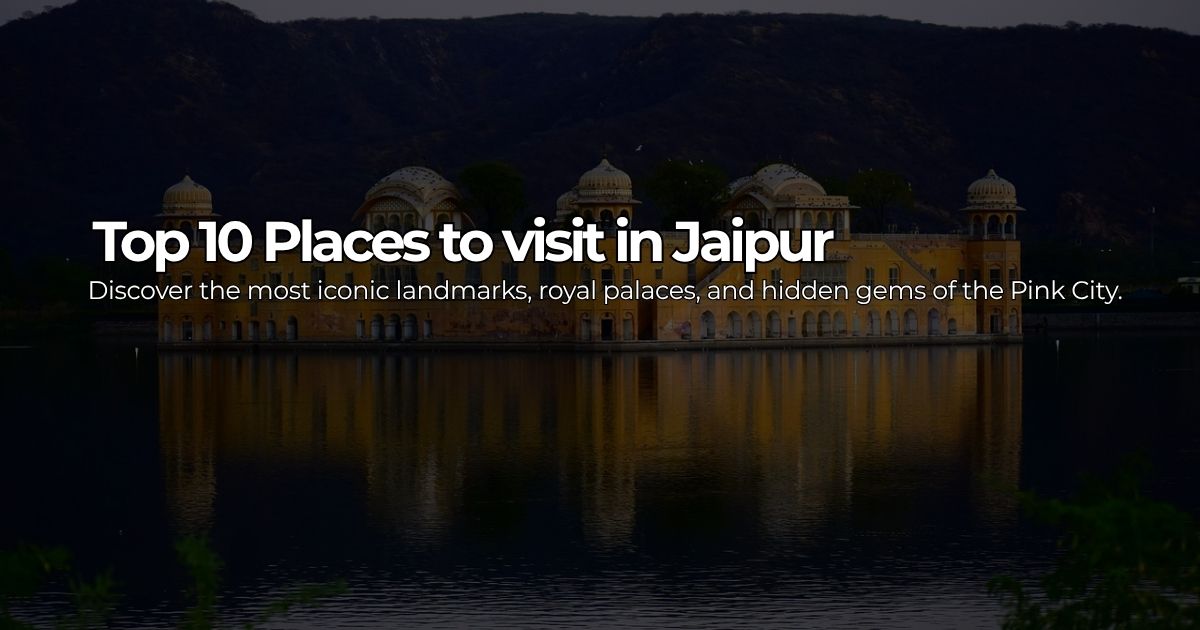
Jal Mahal, which means “Water Palace,” is among the most photographed landmarks of Jaipur. Set in the middle of Man Sagar Lake on the road to Amer, the sandstone palace appears to float on the water, with the Aravalli hills rising behind it. Though modest in size beside the City Palace or Amer Fort, its extraordinary setting has made it a lasting symbol of Rajasthan’s ingenuity, royal taste, and careful use of water in a desert state.
The Origin of Man Sagar Lake
The story of Jal Mahal begins with water. The Amer region has always faced scarcity, and in the late sixteenth century, a severe drought pushed the Kachhwaha rulers to look for a lasting solution. A dam was built across the Darbhawati River to trap the monsoon runoff flowing down from the surrounding hills, and a large reservoir slowly formed behind it. The lake takes its name from Raja Man Singh I of Amer, a celebrated general in Emperor Akbar’s court, who is traditionally credited with the project. For the people of the region, Man Sagar became an important source of water long before any palace stood in it.
Construction of the Palace
Over time, the rulers of the Kachhwaha dynasty began to value the lake as a place of leisure as well as utility. In the eighteenth century, Maharaja Madho Singh I of Jaipur, who ruled from 1750 to 1768, is traditionally credited with building the palace at its centre. It was planned as a royal retreat and hunting lodge, where the maharaja and his guests could spend cool winter days shooting ducks, as migratory birds gathered on the lake in large numbers. Reaching the palace was itself part of the experience, since visitors crossed the water by boat. The building remained a favourite retreat of the Jaipur rulers for generations.
Architecture
Jal Mahal is built of local red sandstone in the Rajput style, with Mughal influences visible in its arches, chhatris, and the octagonal towers at its corners. The palace has five storeys, but when the lake is full, four of them lie beneath the surface and only the top floor can be seen. The surrounding water also helped keep the building cooler during the fierce summer heat of Rajasthan. On the roof, a terraced garden with shaded pavilions offers views of the lake and the hills. The overall effect is one of lightness, as though the building rests gently on the water rather than being anchored to it.
Decline and Neglect
When Jaipur’s princely state merged into the new state of Rajasthan in 1949, the palace lost its royal purpose. For decades it stood largely abandoned. As the city grew, sewage and waste flowed into Man Sagar Lake, silt piled up, and the water became badly polluted. The palace suffered from dampness and decay, and the former hunting retreat turned into a neglected ruin in the middle of a dirty lake.
Restoration and Revival
At the start of the twenty-first century, the Government of Rajasthan handed the palace and the surrounding lake to a private company on a long-term lease, with the aim of restoring both. The work involved cleaning the lake, removing silt, and repairing the palace using traditional materials such as lime and local stone. A landscaped garden was created on the roof, and trees were planted along the shore to bring back bird life. Progress was slowed over the years by legal disputes over the lease and by debates about how the lake should be managed, but the effort brought the palace back from the edge of ruin.
Jal Mahal Today
Today, Jal Mahal remains one of the most beloved sights of Jaipur. Entry to the palace itself has generally been restricted, so visitors admire it from the Man Sagar promenade, especially at sunrise and sunset, when the golden light warms the stone and the water. In winter, migratory birds still visit the lake, echoing the days when royal hunting parties gathered here. With the Nahargarh hills in the background, the palace stands as a reminder of how a drought-driven dam grew into a work of art, and how the rulers of Rajasthan shaped both their landscape and their legacy.
The History of the City Palace of Jaipur
Introduction
The City Palace stands at the heart of old Jaipur, the capital of Rajasthan, and is among the most remarkable royal residences in India. Part palace, part fortress and part museum, it has served as the seat of the Kachwaha Rajput rulers of Jaipur for nearly three centuries. Its courtyards, gateways and pavilions combine Rajput, Mughal and European influences, and the complex remains a living monument: much of it is open to visitors, while a portion is still home to the former royal family. To understand the palace is to understand how Jaipur itself came into being.
Why a New Capital Was Needed
The Kachwaha dynasty originally ruled from Amber, a hill fortress roughly eleven kilometres north of the present city. By the early eighteenth century Amber had become too cramped for a growing capital. Water was scarce, the rocky terrain left little room for expansion, and the court needed space for its administration, army and merchants. Maharaja Sawai Jai Singh II, who had ascended the throne in 1699, decided to build a new city on the open plain to the south. Jai Singh was a capable ruler and soldier, but he was equally a passionate scholar of astronomy, mathematics and architecture, and he approached the project with the mind of a planner. In 1727 he laid the foundation of the new city and named it Jaipur, the City of Jai.
Planning the City and the Palace
Jai Singh entrusted the design of the city to Vidyadhar Bhattacharya, a Bengali scholar and architect who worked in the Amber treasury. Guided by the principles of Vastu Shastra and the classical texts on architecture, Vidyadhar laid out a grid of wide avenues that divided Jaipur into nine rectangular blocks, called chowkris. Two of the nine blocks were set aside for state buildings and palaces, and it was here, at the centre of the city, that the City Palace rose. Construction began around 1729 and the main structures were largely complete by about 1732, after which the Maharaja moved his court from Amber to the new palace.
The Original Palace
The early palace was built in local sandstone and marble, and it followed the Rajput tradition of a series of courtyards linked by gateways and halls. At its core stood the Chandra Mahal, a seven-storey building that became the private residence of the ruling family and remains so today. Nearby were the halls of audience, the Diwan-i-Aam for public gatherings and the Diwan-i-Khas for more exclusive assemblies, along with the apartments of the royal household.
Close to the palace, Jai Singh also built the Jantar Mantar in 1734, an observatory of enormous masonry instruments that reflects his scientific passions and is now recognised as a UNESCO World Heritage Site. He also installed Govind Dev ji, the family’s presiding deity, in a temple within the palace gardens.
Growth Under Later Rulers
After Jai Singh’s death in 1743, the palace continued to grow as each successor added buildings to suit his own tastes. Sawai Pratap Singh, who ruled at the end of the eighteenth century, is remembered for building the Hawa Mahal in 1799, whose honeycomb façade allowed the women of the court to watch street festivities without being seen. In 1818 the rulers of Jaipur signed a treaty with the British and remained on their throne as a princely state, which allowed the palace to stay a centre of court life, ceremony and patronage of the arts.
The Pink City and the Nineteenth Century
Sawai Ram Singh II, who reigned from 1835 to 1880, modernised Jaipur with gas lighting, piped water, and new schools and hospitals. In 1876, to welcome the Prince of Wales, later King Edward VII, the buildings of the city were painted pink, a colour associated with hospitality in Rajput culture. The colour endured, and Jaipur became known across the world as the Pink City.
A Palace for a Modern Age
Sawai Madho Singh II, who ruled from 1880 to 1922, added some of the palace’s most admired features. The Mubarak Mahal, completed around 1900 and designed by Sir Samuel Swinton Jacob, is a fine example of the Indo-Saracenic style, blending Rajput, Islamic and European elements, and it was built to receive distinguished guests. Madho Singh II also commissioned two enormous silver vessels, known as the Gangajali urns, so that he could carry water from the Ganges with him on his voyage to England for the coronation of Edward VII in 1902. Each urn is said to hold about 4,000 litres and is among the largest silver objects in the world. The inner courtyard, Pritam Niwas Chowk, is entered through four richly decorated gateways representing the seasons, of which the Peacock Gate is the most celebrated.
Independence and Transformation
Sawai Man Singh II, the last ruling Maharaja of Jaipur, came to the throne in 1922. After India became independent in 1947, Jaipur joined the Indian Union, and in 1949 it merged with neighbouring princely states to form the state of Rajasthan, with Man Singh II serving as its Rajpramukh. Royal rule came to an end, but the palace did not fade away. In the decades that followed, a large part of it was opened to the public as the Maharaja Sawai Man Singh II Museum, while the family kept its private residence within the complex.
The Palace Today
Today the City Palace is one of Jaipur’s leading attractions. Its museum displays royal costumes, textiles, weapons, manuscripts, paintings and carpets, offering a detailed picture of the court culture of the Kachwaha kings. The Chandra Mahal continues to house the royal family, and a flag flying above it traditionally signals that the Maharaja is in residence. The palace also hosts weddings, cultural events and festivals, so its old courtyards still ring with ceremony.
History of the Albert Hall Museum, Jaipur
Introduction
The Albert Hall Museum stands in the heart of Jaipur, inside the green expanse of Ram Niwas Garden, and is among the most admired buildings in Rajasthan. Officially known as the Government Central Museum, it is widely regarded as the oldest museum in the state and a striking example of Indo-Saracenic architecture. Named after Albert Edward, Prince of Wales, the building carries a story of royal ambition, colonial-era diplomacy, and a determination to preserve India’s traditional craftsmanship.
Jaipur in the Nineteenth Century
Founded in 1727 by Maharaja Sawai Jai Singh II, Jaipur had grown by the nineteenth century into one of the most important princely states of Rajputana. Under Maharaja Sawai Ram Singh II, who ruled from 1835 to 1880, the city entered a period of steady modernisation. He encouraged schools, an art school, piped water, and gas lighting, and he took a personal interest in public works.
Ram Niwas Garden itself was laid out in 1868 as a famine-relief project, giving employment to people struggling through a harsh season. It was in this setting, with a ruler open to new ideas and a British administration eager to display its friendships with Indian princes, that the idea of a grand public building took shape.
The Prince’s Visit of 1876
In the winter of 1875 and 1876, Albert Edward, Prince of Wales and eldest son of Queen Victoria, toured India. Jaipur prepared to receive him with extraordinary care. The old city was painted pink, a colour associated with hospitality in Rajput tradition, and this welcome is the origin of Jaipur’s enduring nickname, the Pink City.
On 6 February 1876, the Prince laid the foundation stone of a new building that would be named Albert Hall in his honour. It was originally conceived as a town hall, a place for public gatherings and civic events. Ram Singh II, who had invited the Prince and championed the project, did not live to see it finished, for he died in 1880.
Design and Architecture
The building was designed by Sir Samuel Swinton Jacob, an engineer in the service of the Jaipur State and one of the leading figures of the Indo-Saracenic style. He was assisted by Mir Tujammul Hussain, and a large body of local masons, carvers, and painters gave the design its finish.
Indo-Saracenic architecture blended Rajput and Mughal elements with Islamic forms and touches of European design. Albert Hall reflects this mixture clearly. Built in sandstone and marble, it has graceful arches, open arcades, domed pavilions known as chhatris, and delicate carved detail. The result is a building that looks unmistakably Indian while still speaking the architectural language of its time. Its symmetrical facade and raised platform give it a dignified, almost palatial presence within the garden.
The setting adds to its charm. Ram Niwas Garden, with its lawns, old trees, and quiet walkways, provides a calm frame for the building, and its position just outside the walled city made it easy for residents and visitors to reach. Its wide steps and open surroundings soon became a place where people gathered, fulfilling in a new way the public purpose that the hall was first meant to serve.
Construction and Opening
Work continued for about a decade after the foundation stone was laid. By the time the structure neared completion, Maharaja Sawai Madho Singh II had succeeded to the throne, and the purpose of the building had changed. Instead of a town hall, it would become a museum, a home for the arts and crafts of the region and beyond.
This shift owed much to Colonel Thomas Holbein Hendley, a British surgeon and enthusiast of Indian art who served as secretary of the museum. In 1883 he helped organise the Jeypore Exhibition, which gathered outstanding examples of metalwork, textiles, pottery, and carving from across India. Many objects from that exhibition formed the foundation of the museum’s collection. The building was formally opened in 1887 by Sir Edward Bradford, the British representative in Rajputana, and it began its long life as the Albert Hall Museum.
The Collections
The museum’s collections are remarkably wide. Visitors can see Mughal and Rajput miniature paintings, ivory carvings, brassware, woodwork, stone and marble sculpture, textiles, jewellery, arms and armour, musical instruments, and finely worked crystal. Persian carpets of great age and beauty are among its treasures, as is the well-known Navaratna Durbar painting.
One of its most famous attractions is an Egyptian mummy, which continues to draw curious crowds of all ages. Together, these objects show how Jaipur’s rulers valued both local artistry and the wider wonders of the world, and they make the museum a valuable record of the region’s artistic life.
Later Years and Legacy
After India’s independence and the formation of Rajasthan, the museum came under the care of the state’s Department of Archaeology and Museums. Over the decades it has undergone conservation work to protect both its building and its artefacts. Today it is one of the most visited monuments in Jaipur, and at night, when the facade is lit, it becomes one of the city’s most photographed sights.
Albert Hall has also become a symbol of Jaipur itself. It appears on postcards, in travel writing, and in the memories of countless visitors who come to the Pink City. For students, artists, and historians, it remains a place where the crafts and traditions of Rajasthan can be studied at close quarters. Its role has never been merely decorative, since it continues to work as a living classroom for anyone curious about the region’s past.
Hawa Mahal, Jaipur
Introduction
Hawa Mahal, known as the Palace of Winds, is one of the most recognisable landmarks of Jaipur and of Rajasthan. Made of red and pink sandstone, its curved front rises five storeys above the busy street of Badi Choupad. The building is famous for its honeycomb-like facade, which is covered with hundreds of small windows and delicate latticework. The structure is about fifteen metres high, and though it looks like a grand palace from the street, it is really a tall, elegant screen.
History
Hawa Mahal was built in 1799 by Maharaja Sawai Pratap Singh, the grandson of Jai Singh II, the founder of Jaipur. Pratap Singh ruled from 1778 to 1803 and was a poet, a lover of music and a devoted follower of Lord Krishna. The palace was designed by the architect Lal Chand Ustad, and its unusual shape is often said to resemble the crown of Krishna. Historians believe the design was partly inspired by the Khetri Mahal in Jhunjhunu.
The palace was built as an extension of the City Palace, reaching toward the women’s quarters. In royal Rajput households, women followed the custom of purdah and could not appear openly in public. Hawa Mahal solved this problem, because the royal women could sit behind its screens and watch street processions, festivals and daily life below without being seen from outside.
In 1876, Maharaja Sawai Ram Singh II had Jaipur painted pink to welcome the Prince of Wales, the future King Edward VII. Since then, the city has been known as the Pink City, and Hawa Mahal is its most photographed symbol.
Architecture
The facade has 953 small windows, called jharokhas, each with fine carved screens. These screens allowed the women to see out while remaining hidden. They also served a practical purpose. Air passing through the many small openings creates a cooling effect, so the palace stays comfortable even in the fierce summer heat, and this is how it earned its name. Its walls also glow golden in the morning sun and deep rose at sunset.
The architecture combines Rajput and Mughal styles. The domed canopies and floral patterns reflect Rajput tradition, while the arches and lattice work show Islamic influence. The top three floors are only one room deep, and the palace has five levels, each with its own name, including Sharad Mandir, Ratan Mandir, Vichitra Mandir, Prakash Mandir and Hawa Mandir. Instead of staircases, ramps connect the upper levels.
Visiting Today
Today Hawa Mahal is a protected heritage monument and one of the busiest tourist attractions in Jaipur. Visitors enter from the rear, near the City Palace, and can walk through courtyards and small chambers before reaching the upper floors, where the views of the city and the nearby Jantar Mantar are memorable. A small archaeological museum is also located inside. Early morning is the best time to see the facade in soft light and take photographs before the large crowds arrive.
Hawa Mahal remains a beautiful reminder of royal life, artistic skill and clever design in Rajasthan.
Jantar Mantar, Jaipur
Introduction
Jantar Mantar in Jaipur is one of the most remarkable astronomical observatories in the world. Standing beside the City Palace, it is a collection of nineteen instruments made of stone and marble, each designed to measure time, track the sun, moon and planets, and predict celestial events. In 2010, UNESCO added it to the World Heritage List, calling it the most significant, comprehensive and best preserved of India’s historic observatories.
History
The observatory was built by Maharaja Sawai Jai Singh II, the ruler of Amer who founded the city of Jaipur in 1727. Jai Singh was a capable administrator and warrior, but he was also a passionate scholar of mathematics and astronomy. He noticed that the astronomical tables of his time, inherited from Greek, Arab and Central Asian scholars, often disagreed with what could actually be seen in the sky.
Determined to correct these errors, Jai Singh planned a series of observatories across northern India. The first was raised in Delhi in 1724, followed by those at Jaipur, Ujjain, Varanasi and Mathura. The Jaipur observatory was completed around 1734 and became the largest and most elaborate of the five. Mughal emperor Muhammad Shah encouraged the project, and the revised tables that Jai Singh prepared were named Zij-i Muhammad Shahi in his honour.
Over the years, the observatory slipped into neglect. Maharaja Sawai Madho Singh II ordered its restoration in 1901, and it later came under government protection as a monument of national importance.
The Instruments
The instruments were built on a giant scale, because larger structures allow more precise readings. The most famous is the Samrat Yantra, meaning the Supreme Instrument. This enormous sundial rises about twenty-seven metres, and its shadow can show local time with an accuracy of roughly two seconds.
The Jai Prakash Yantra consists of two bowl-shaped hemispheres marked with scales, which help determine the sun’s position in the sky. The Ram Yantra is a pair of cylindrical structures used to measure the altitude and direction of celestial bodies. The Rashivalaya Yantras are twelve separate instruments, one for each zodiac sign, that show the position of each sign at the moment it crosses the meridian.
Significance
Jantar Mantar is important because it shows how advanced Indian astronomy was in the early eighteenth century. All the observations were made with the naked eye, since the instruments contain no lenses or telescopes. The observatory also reflects the blending of ideas from Hindu, Islamic and European astronomical traditions, which Jai Singh studied.
Astronomy in India was closely linked with astrology, calendars and the timing of religious festivals, so these instruments served both scientific and cultural needs. Even today, scholars and astrologers of Jaipur remain interested in its readings.
Visiting Today
Jantar Mantar is one of the most popular attractions in Jaipur and is only a short walk from Hawa Mahal. Visitors can climb the Samrat Yantra, examine the zodiac instruments, and learn how people once understood the heavens. It stands today as a lasting tribute to the curiosity and vision of Maharaja Sawai Jai Singh II.
Nahargarh Zoological Park, Jaipur
Introduction
Nahargarh Zoological Park, officially known today as Nahargarh Biological Park, is one of the most popular wildlife destinations near Jaipur, the Pink City of Rajasthan. Set among the rugged Aravalli hills, the park combines a natural forest habitat with modern safari facilities. Visitors can see big cats and other animals in surroundings that feel far more natural than those of a traditional zoo. The park has become an important addition to Jaipur’s tourism, which was earlier known mainly for its forts, palaces and bazaars.
Location and Background
The park lies about 12 kilometres from Jaipur, along the Jaipur–Delhi highway, close to Amer. It is part of the larger Nahargarh sanctuary and spreads over roughly 720 hectares. Reports from 2013 said that work would begin on a zoological park funded by the Japan International Cooperation Agency, and that the old Jaipur Zoo, established in 1877, could later be shifted there. Over time, the project developed into a biological park that focuses on large, natural enclosures and wildlife conservation rather than small cages.
Wildlife and Safaris
The main attractions of the park are its safaris. The lion safari covers around 30 hectares, where Asiatic lions roam in a fenced but spacious area, and visitors watch them from a vehicle. More recently, a tiger safari was inaugurated on 7 October by Rajasthan Chief Minister Bhajan Lal Sharma. It spreads over about 32 hectares, has figure-eight tracks for easy viewing, and was built at a cost of around ₹4.5 crore. Three tigers were introduced in the first phase, and visitors travel in vehicles fitted with safety cages on a ride that lasts about one hour.
Apart from lions and tigers, the park is home to leopards, hyenas, sloth bears and several kinds of deer. Birdwatchers also enjoy the park, as more than 285 species of birds have been recorded here, including both resident and migratory birds.
Nature, Views and Education
The hilly Aravalli landscape, with its dry deciduous forest and native trees, gives the park a peaceful and scenic atmosphere. The elevated location offers pleasant views of the surrounding countryside, and the trails are popular with people who like walking and photography. The park also helps in spreading awareness about wildlife protection. Information boards and guided visits teach students and families about animals, their habitats, and why conserving forests and endangered species is important.
Visitor Information
According to Incredible India, the park opens at 8:30 AM and closes at 5:30 PM, and it is usually closed one day a week. The entry fee has been reported as ₹200 per person, though separate charges may apply for safaris, vehicles and cameras. The best time to visit is from October to March, when the weather is cooler and animals are more active. Since timings and fees can change, visitors should check the latest details before planning a trip.
Visitors should carry drinking water, sunscreen and sturdy shoes, follow the instructions of the staff and guides, keep a safe distance from animals, and never feed or disturb them.
Conclusion
Nahargarh Zoological Park is a valuable blend of wildlife, nature and education, located just a short drive from the heart of Jaipur. With its lion and tiger safaris, rich birdlife and scenic hills, it offers a memorable experience for students, families and nature lovers alike. As it continues to grow, the park can play a significant role in wildlife conservation and in making Jaipur a complete destination for both heritage and nature tourism.
Gate, Jaipur: A Colorful Gateway to Rajasthan’s Heritage
Patrika Gate is one of the most beautiful and recognizable landmarks in Jaipur, Rajasthan. Located at Jawahar Circle in the Mansarovar area, this magnificent gateway welcomes visitors with its colorful architecture, detailed artwork, and traditional Rajasthani design. Over the years, Patrika Gate has become a popular attraction for tourists, photographers, and locals who want to experience the artistic beauty of Jaipur.
Unlike many historic monuments in Jaipur, Patrika Gate is a relatively modern landmark. However, its architecture and artwork beautifully represent the cultural heritage, traditions, and history of Rajasthan. Its colorful interiors make it one of the most photographed places in the Pink City.
Where Is Patrika Gate Located?
Patrika Gate is located at Jawahar Circle, near Jawahar Lal Nehru Marg in Jaipur. It is situated close to Jaipur International Airport, making it an easily accessible attraction for visitors arriving in the city by air.
The gate stands at the entrance of Jawahar Circle Garden, which is known as one of Asia’s largest circular parks. Because of its location, visitors can easily combine a visit to Patrika Gate with a relaxing walk through the garden.
The location is also convenient for people staying in areas such as Mansarovar, Malviya Nagar, Jagatpura, and nearby parts of Jaipur.
Architecture and Design
The most attractive feature of Patrika Gate is its colorful and artistic architecture. The structure showcases elements inspired by the traditional architecture of Rajasthan. Its walls, pillars, arches, and ceilings are decorated with intricate paintings and patterns.
As you walk through the gate, you can see colorful murals depicting different aspects of Rajasthan. These artworks represent royal traditions, local culture, historical places, festivals, landscapes, and everyday life.
The combination of pink, yellow, blue, green, and other bright colors creates a vibrant atmosphere. The detailed artwork makes almost every section of the gate interesting to photograph.
The design also reflects the artistic identity of Jaipur, a city famous for its palaces, forts, painted buildings, handicrafts, and traditional architecture.
Why Is Patrika Gate Famous?
Patrika Gate has become famous mainly because of its beautiful appearance and photography-friendly surroundings. The symmetrical arches and colorful paintings create an attractive background for photographs.
Many visitors come here during the early morning or evening to take pictures when the light is softer. The central passage of the gate is particularly popular for portraits, travel photography, wedding photography, and social media content.
For travelers visiting Jaipur for the first time, Patrika Gate offers a quick introduction to Rajasthan’s colorful artistic culture without requiring a long visit.
Best Time to Visit Patrika Gate
The best time to visit Patrika Gate is generally during the morning or evening. Early morning can be a peaceful time for photography because there are usually fewer visitors and the natural light can create a pleasant atmosphere.
Evening is another popular time because visitors can enjoy the surroundings of Jawahar Circle Garden. The area becomes lively as people come for walking, photography, and leisure activities.
If photography is your main purpose, visiting earlier in the day can help you get clearer photographs with fewer crowds.
Things to Do Near Patrika Gate
A visit to Patrika Gate can easily be combined with other activities around Jawahar Circle. Visitors can explore the garden, enjoy a walk, take photographs, and spend some relaxing time outdoors.
The area is also surrounded by restaurants, cafés, shopping areas, and other attractions. Since the gate is located near the airport, it can be a convenient place to visit before or after a flight if your schedule allows.
Travelers can also include Patrika Gate in a Jaipur sightseeing plan along with attractions in nearby areas.
Photography at Patrika Gate
Photography is one of the main reasons people visit Patrika Gate. The colorful paintings provide many different backgrounds, while the symmetrical architecture makes it suitable for both portrait and architectural photography.
Travel bloggers and content creators can also use the location to create attractive travel photographs and videos. To get the best results, try photographing the gate from the central passage and explore different angles to capture its detailed artwork.
Visitors should be respectful of other people while taking photographs and should follow any local rules regarding professional or commercial photography.
Patrika Gate for First-Time Jaipur Visitors
For someone visiting Jaipur for the first time, Patrika Gate is a simple and visually impressive place to add to a travel itinerary. It does not require a full day, so travelers can visit it while exploring other parts of the city.
Its colorful artwork provides a different experience from Jaipur’s famous forts and palaces. While places such as Amber Fort, City Palace, and Hawa Mahal showcase the city’s historical and royal heritage, Patrika Gate presents Rajasthan’s artistic traditions through a modern architectural landmark.
Conclusion
Patrika Gate is more than just an entrance to Jawahar Circle. It has become a recognizable symbol of Jaipur’s colorful artistic identity. Its detailed paintings, traditional-inspired architecture, vibrant colors, and convenient location make it an attractive stop for tourists and photography lovers.